



Opens in a new tab
0
Request a Quote
buying-guides-banner

Resources · Choosing Uniforms

Buying guides for
healthcare uniforms

Most uniform regret comes from a decision nobody realised they were making. These guides cover the ones that matter before you order.

1,000+

Healthcare organisations

60,000+

Garments supplied

40+

Years experience

95%+

Client reorder rate

5.0 Google Rating

Why this is worth reading first

The garment
is the easy part

Choosing a uniform looks like a shopping decision and behaves like a policy one. The style is settled in an afternoon; what comes attached to it is lived with for years. These are the decisions that are cheap to make well now and expensive to revisit later — and they usually get made by default, by whoever happened to be placing the order.

One afternoon

A shopping decision

A garment, in a colour, chosen from a photograph and signed off between other things.

Role
Colour
Fabric
Quantity
Branding
Ordering
Replacement
One afternoon

A shopping decision

A garment, in a colour, chosen from a photograph and signed off between other things.

Every day after

An operating decision

Seven things follow from it, and every one of them outlives the first order.

Before you order

Six things worth deciding once

None of these are difficult on their own. What makes them expensive is deciding them differently each time somebody orders.

The range

Defined once, before anything is ordered.

Role

Which garments each role wears

Colour

The colours permitted for your team

Quantity

How many sets a person receives

Branding

Where the logo sits, and on what

The routine

Then decided once, and repeated.

Ordering

Who is allowed to order

Replacement

How a worn garment gets replaced

Choosing by role

One range rarely
means one garment

A clinician, a receptionist and an allied health practitioner do different work in the same building. Putting all three in the same garment usually means it suits one of them and is tolerated by the other two.

The workable approach is one coordinated range with several garments inside it — scrubs, tunics, polos or shirts as the role requires — held together by a shared colour palette and branding standard. The team still reads as one organisation without forcing every role into the same garment.

Different jobs. One coordinated organisation.

By setting

Guides by sector

The decisions are the same everywhere. What changes is the setting they have to work in, and what the people wearing the uniform spend the day doing.

Learned the hard way

Where uniform decisions usually go wrong

Not hypotheticals. These are the reasons organisations end up changing a range earlier than they planned to.

Selection errors

Made while choosing the range

Chosen on a photograph

A garment picked from an image rather than handled, then found to be wrong on the floor.

One garment for everyone

A single style forced across roles it was never designed for.

Colour chosen last

A palette settled after the garments, so the range cannot extend cleanly.

Program errors

Made while running it, long after

No decision on quantity

Nobody agreed how many sets a person gets, so it varies by who asked.

Branding left to the end

A logo applied to a garment that was never assessed for it.

No plan for replacement

The first order is considered; the second is improvised.

Where this leads

Once the range is settled

Choosing the range is the first decision. Once that is settled, branding, ordering rules and replacement become much easier to standardise.

01

Choose the range

Garments, colours and quantities,
by role.

02

Set the branding

Artwork prepared once and applied to one standard.

03

Set the rules

Who orders, what is approved, how replacements work.

04

Run it

Staff order from what has already been decided.

Four decisions, a year later.
Nobody notices a uniform that was decided properly.

Common questions

Choosing healthcare uniforms — frequently asked questions

With roles. Decide what each group of staff actually does in a day, then choose garments to suit that. Colour, branding and ordering rules all follow more easily once the roles are settled.

Rarely. Most organisations use one range with several garments inside it, held together by a shared colour palette and one branding standard. That reads as consistent without forcing an unsuitable garment on anyone.

It depends on how often the uniform is laundered and how physical the role is. What matters more is that the number is decided once and applied consistently, rather than varying by who asks.

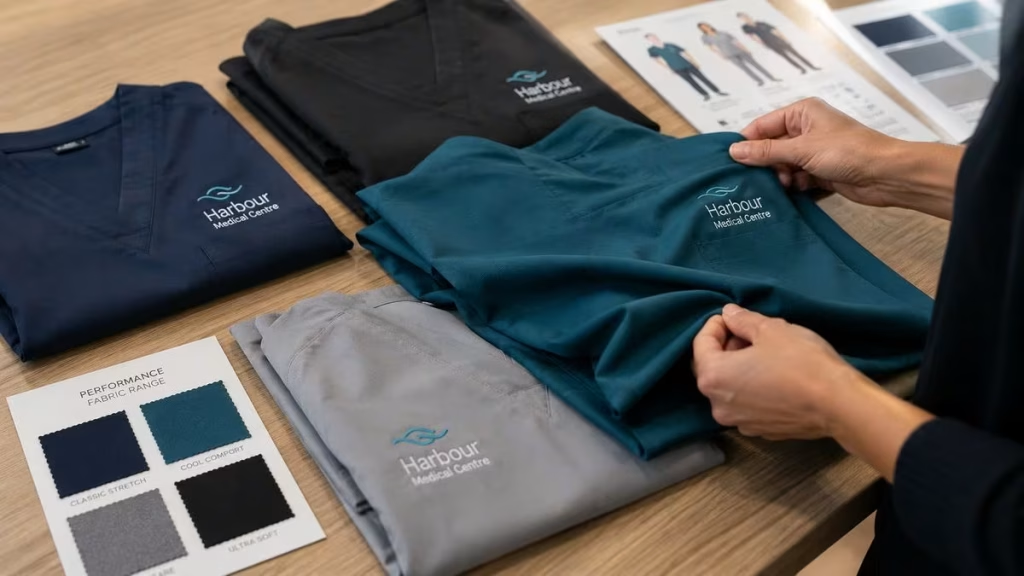
Yes. Fabric and fit are difficult to judge from a photograph, and most organisations want to handle the garments before committing a whole team to them.

Ranges do change. Where a style is discontinued, the closest suitable option is identified and confirmed with you rather than substituted quietly, and your program is updated so future orders use it.

No. Many organisations settle the core garments first and add items — outerwear, additional roles, seasonal options — as they become necessary.

No. A program is a way of managing the range once it exists. You can choose garments without one, though the decisions in these guides are what a program would hold on your behalf.

Whoever has to live with it. The people wearing the garments have the most useful opinions about comfort and practicality; the person managing ordering has the most useful opinions about everything else.

Size & Fit Guide

×

Avery is cut for a contemporary, slightly tapered fit that flatters without restricting movement. Prefer a relaxed fit or planning to layer? Size up.

Model — Women's5'7", wearing size S
Model — Men's6'1", wearing size L
FitTrue to size, tapered body
LengthHip-length, V-neckline
Chest (CM)Body LengthSleeve
XXS81–865830.5
XS86–916031.5
S91–976232.5
M97–1026433.5
L102–1076634.5
XL107–1146835.5
2XL114–1227036.5
3XL122–1327237.5
4XL132–1427438.5

Uniform solutions
for your healthcare team.

Quality
Uniforms
Fit for
Your Team
Ongoing
Support
Request a Quote

Tell us about your
uniform needs

Whether you’re ordering for a small practice or a larger healthcare organisation, send us a few details and we’ll get back to you.

Number of staff
We'll only use these details to respond to your quote request.
OR

Prefer to talk? Call 1300 736 665

Our team will be in touch shortly to discuss your requirements.